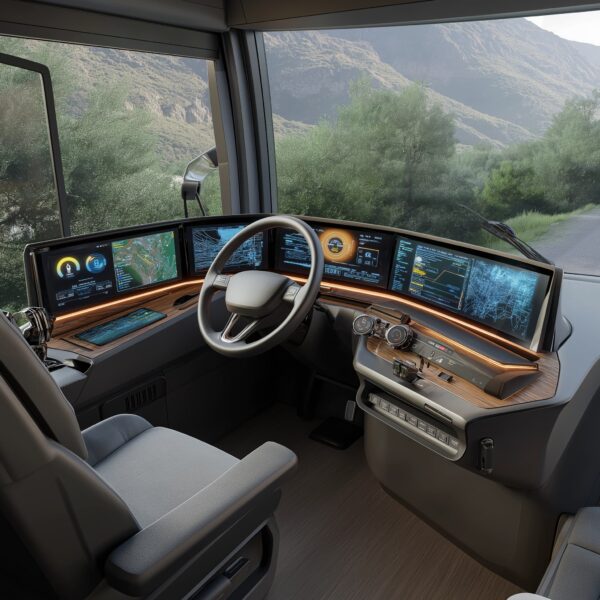
The driver’s cab is one of the most critical yet often overlooked components of public transport vehicles. While passengers focus on comfort and appearance, the cab determines safety, visibility, ergonomics, and operational efficiency. Throughout the history of public transport, changing technology, urban conditions, and labor practices have led to a wide range of unusual driver cab designs. Some were bold innovations, others practical compromises, and a few remain curious experiments shaped by their time.
In the early days of motorized public transport, driver cabs were minimalistic and exposed. Many early buses and trams featured open or semi-open cabs with little protection from weather. Drivers wore heavy coats and goggles, especially in colder climates. These designs prioritized mechanical simplicity over comfort, reflecting an era when vehicles were still evolving from horse-drawn transport. While uncomfortable, open cabs offered excellent visibility and direct communication with the street environment.
As vehicles became enclosed, some designers experimented with extreme isolation. In several mid-20th-century buses, especially in Europe, driver cabs were fully sealed from passenger areas by solid walls and narrow sliding doors. The goal was to reduce distractions and improve fare control. In certain models, drivers communicated with conductors or passengers only through speaking tubes or signal lights. These enclosed cabs improved focus but often led to poor ventilation and a sense of isolation.
One of the most unusual approaches appeared in double-decker buses, where cab placement varied significantly. Some early double-deckers positioned the driver unusually low, almost at street level, with limited upward visibility. Others placed the cab slightly offset or recessed to accommodate staircases. In rare cases, experimental designs attempted elevated driver positions to improve road awareness, but these proved impractical due to stability and access issues.
Trams and streetcars introduced their own cab peculiarities. In many early tram systems, the driver stood rather than sat, operating large control wheels or levers. Standing cabs allowed better visibility in crowded streets but caused long-term physical strain. Some systems later adopted fold-down seats or hybrid standing-sitting positions. These designs reflected a time when driver endurance was expected rather than optimized.
Post-war public transport saw an emphasis on ergonomics, but experimentation continued. In the 1960s and 1970s, futuristic cab layouts appeared, inspired by aviation and industrial design trends. Wraparound dashboards, angled control panels, and panoramic windscreens became more common. Some buses featured asymmetric cabs with controls shifted sideways to improve mirror visibility. While visually striking, these layouts sometimes confused drivers accustomed to traditional configurations.
Another unusual design trend involved shared or flexible cab spaces. In some articulated buses and experimental metro vehicles, the cab could be partially opened to passengers during off-peak hours. The idea was to improve security through visibility and reduce barriers. However, noise and distraction quickly became problems, leading most systems to return to more traditional separation.
Island and narrow-city environments also influenced cab design. In cities with tight streets and constant pedestrian interaction, driver cabs were sometimes designed with exaggerated glass areas for maximum situational awareness. Large curved windows, extended side glazing, and low dashboard profiles improved sightlines. While effective for safety, these designs increased heat exposure and glare, requiring additional shading solutions.
In colder regions, unusual cab designs focused on insulation and protection. Some buses in northern climates featured heavily reinforced cabs with double glazing, thick doors, and elevated floor levels to prevent cold air infiltration. In extreme cases, driver compartments resembled small control rooms, prioritizing warmth over openness. These designs highlight how climate directly shaped vehicle architecture.
Automation experiments introduced some of the most radical cab concepts. During early trials of semi-automated buses and trains, designers reduced cab size dramatically or eliminated traditional seating altogether. Some prototypes featured retractable driver stations, allowing vehicles to operate manually or autonomously. While these designs pointed toward the future, regulatory and safety concerns limited their widespread adoption.
Historic fare collection systems also influenced cab layouts. When drivers were responsible for ticket sales, cabs were positioned to allow easy interaction with boarding passengers. This often resulted in cramped entry zones and awkward seating positions. As conductors disappeared and automated ticketing became standard, cab designs shifted again, freeing space but also changing driver responsibilities.
Not all unusual cab designs were successful. Some created blind spots, increased fatigue, or complicated maintenance. Yet even failed designs contributed valuable lessons. Modern public transport cabs now emphasize ergonomics, standardized controls, climate regulation, and safety barriers. These improvements are the result of decades of experimentation, including many unconventional attempts.
The history of driver cab design reveals how public transport evolves through trial and adaptation. Each unusual cab reflects specific pressures, whether technological limits, urban form, labor practices, or cultural attitudes toward work and safety. While passengers may never notice these details, the driver’s cab remains a quiet record of transport innovation. Studying these designs offers insight into how cities balanced efficiency, safety, and human factors as public transport systems developed.